Wednesday, June 22, 2011
One more thing...
Another thing I had forgotten to mention. My blog is now public. Before it was private, but towards the end of the project, since it wasn't violating anyone else's privacy, I decided to make it public since it was much easier than adding all of my evaluators. Enjoy everyone!

The finished product
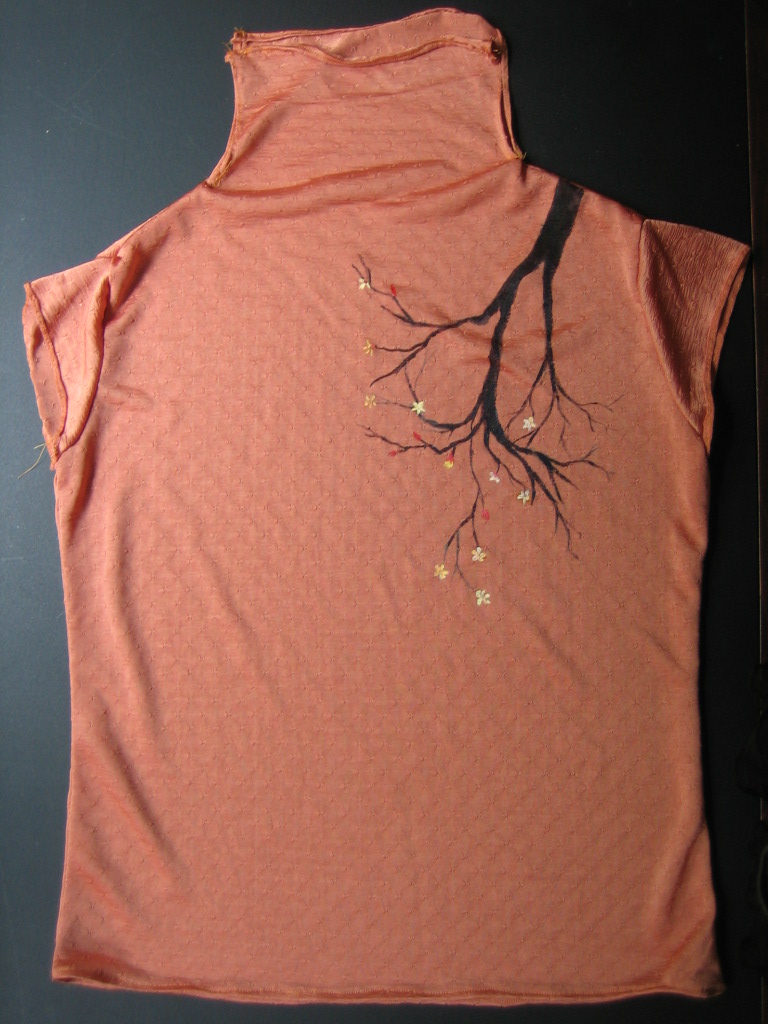
Sorry this is so late! During my presentation, I realized that I had left my shirt at home after trying it out. It's a pity I could only show you one of the pieces that I had completed. Here is the other one...

Thursday, June 9, 2011
Last Post
This is my last post, and farewell. I've decided that I won't give you any updates now until my presentation. There's one more dress to be completed, so you'll just have to wait and see! It'll be a surprise!
Tuesday, June 7, 2011
Library Book 4
Fashion: Color, Line, and Design
by Susan Geringer
Third Edition
This book has SOOOO much info!! I have been using all of these library books since I got them, but mainly looking for specific things, and not just flipping through idly. I won't be able to take notes on this one like I did on the other ones, because otherwise I will be writing all night long. To give you an idea of the breadth of information that this book covers, I'm going to try to summarize
1. Color
a) Psychology of color and symbolism- how color makes people feel, and traditional colors (white for a western wedding)
in order of preference from liked to less liked, colors are ranked as such: blue, red, green, violet, orange, and yellow
People usually like light more than dark colors, and primaries (red, yellow, blue used to mix all other colors) and pure colors more than intermediates (combination of colors) and grayed ones
introverts like neutral, extroverts like bright, neutral considered more sophisticated
hot climates, cool colors, cool climates, warm colors
Color gives messages and causes reactions- increase heart rate w/ red, decrease w/ blue
favorite colors show personality (my favorite is orange/yellow- orange is exciting and glowing, yellow, most luminous, is cheerful, creative, intellectual, but also least liked because think of sickness and cowardice)
bright colors, good mood, dark colors, bad mood
color/patterns must be used either traditionally, or very unorthodox
Chapter 2- Clothing Details
gives an overview of standard shapes and cuts in clothing (A-line skirt, camisole, dress shirt, draped, blazer, bomber jacket, mandarin, nehru jacket, sweetheart neckline, kimono sleeve etc) and construction detailing (beading, bias, braids, buttons, cording, darts, embroidery, facing, fringe, frogs, hem, piping...) It goes on for a while, and is very dated (grossly dated... sometimes it makes you cringe. Seriously, a safari jacket?? Pedal pushers?????), and is pretty much vocab, and lists pretty much everything they can think of, so we shall skip this part, though some of the names are funny, like peplum" (pretty much a tunic and a pencil skirt as a suit), however the names are the same as in Library book 2, so that's reassuring!
Chapter 3- Design Lines
Pretty much how to draw... Did you know an S shaped line is called an Ogee? They also talk about angles, silhouettes (tubular, hourglass, bell, etc), proportion, balance, emphasis, rhythm (repetition in pattern, color, trimming, etc), harmony (unity of the look)
Chapter 4- Fashion Drawing
Basic figure drawing, proportion of human body, and the balance line (your spine), drawing clothing around curves, draped cloth, making it how the customer wants it, body size and figure, and color and texture... I think I got this part down
FINALLY
Chapter 5- History of Costume
Pretty much half of the book, and what I was waiting for.
Reasons to wear clothes: Protection, modesty, adornment, status, belonging to a group, sexual attraction (ooh!)
People either like skinny girls, big buts, or big boobs, or a combo (I'm just turning the technical language into straight forward wording, I promise!)
skinny tubular figure was popular when women had power- look like man, popular in ancient Egypt, flappers, WWII, 1980s
Big bust/waist (bell silhouette) when women were weakest (Victorian times, Southern Belles before Civil War, and 1950s poodle skirt)
Supposedly studies by Harris, Uphan, and Co. to show that women's hemlines were directly proportional to the stock market (also mentioned in Lib book 2)
in the 20th century, fashion inspired/influenced by celebrities and films
Egyptians (2800 BC-300 BC)
sun inspired- rays of the sun in pleating/jewelery
body=soul's temple- well kept- sheer, form fitting clothes showed off body, removed body hair, wore wigs, heavy make-up around eyes (mirrors to the soul)
black kohl around eyes also protected from sun
Men wore shenti around waist- triangle shaped like pyramid
women wore transparent linen gowns, or kalasiris, with pleating and collar
Cretans 2500 BC-1100 BC
vain/proud of bodies, small waists, sew own garments so they were original
considered best dressed women in history
small waists due to soldering belts on children at age six for hourglass figure
chiton- two rectangular cloths attached at shoulder, laced at waist
puffed cap sleeve, bolero jacket, and other styles adopted from neighbors
Greeks influenced by Cretans, esp w/ chiton
himation was outergarment- intricately wrapped, social status implied by draping and control of wearer
Middle Ages- we all know how that looked
However, crusades brought eastern cultures
**gothic movement caused pointy cone hats to emerge, or hennin (think princess hat)- sometimes so long needed servant to follow w/ pitchfork- law passed- length determined by husband's profession
Chopines- extremely high platform shoes
bliaud- tight boddice, full skirt, and long, full sleeves w/ low waistline- most common 12-13 centuries
Maternity became popular at one point due to belief that they had found the Virgin Mary's tunic- pregnancy pillow to look pregnant
*codpiece- sac at men's groin which were decorated and stuffed with fabric or even coins :P
16th century
farthingale- stiff structure under skirt to make it poof out
vasquines- iron corsets w/ bolts to flatten breasts, stomacher flattened stomach
perfumes to disguise that people didn't bathe
big ruffed collars- needed long utensils to eat
Pumpkin breeches- for men, padded on the butt so that resembled pumpkins
Seventeenth Century
"Sun King" Louis XIV
lower necklines, massive hair, small cap for mourning with deep point on forehead known as widow's peak
Men wore huge pants, so padded they were like skirts, and a thin cravat, or tie
18th Century
justaucorps (think Mozart)
wigs less popular
after French Rev, outlandish fashions- long tails, jacket left open because too tight, double breasted buttons, trousers completely visible (no tunic), ankle length, not at knee
youth mocked formality of the king- wore more wrinkled, careless look
... goes on and on in great detail on how the fashion transformed slowly over time...
19th century
Greek look
Godey's Lady Book as first fashion magazine
Dandies- well groomed me (think Napoleon)
Sports wear created
painful lacing and bodices, considered distasteful for women to eat in public- fainted
hourglass figure became more popular, some removed ribs to become thinner, monobosom- leaned forward
20th century
confining garments abandoned after WWI (example, "hobble skirt")
flapper emerged 1920s
1930s thin, long, formfitting (evening gown)
WWII manly look w/ suit w/ big shoulders- display of wealth was tasteless
skirts shortened
gloves popular
miniskirt
two-piece suits
hippie
warp dress
punk/disco
90s layering and drabness...
By the way, I think that this is a textbook, since it has "projects" to do after every chapter. Should have done those...?
by Susan Geringer
Third Edition
This book has SOOOO much info!! I have been using all of these library books since I got them, but mainly looking for specific things, and not just flipping through idly. I won't be able to take notes on this one like I did on the other ones, because otherwise I will be writing all night long. To give you an idea of the breadth of information that this book covers, I'm going to try to summarize
1. Color
a) Psychology of color and symbolism- how color makes people feel, and traditional colors (white for a western wedding)
in order of preference from liked to less liked, colors are ranked as such: blue, red, green, violet, orange, and yellow
People usually like light more than dark colors, and primaries (red, yellow, blue used to mix all other colors) and pure colors more than intermediates (combination of colors) and grayed ones
introverts like neutral, extroverts like bright, neutral considered more sophisticated
hot climates, cool colors, cool climates, warm colors
Color gives messages and causes reactions- increase heart rate w/ red, decrease w/ blue
favorite colors show personality (my favorite is orange/yellow- orange is exciting and glowing, yellow, most luminous, is cheerful, creative, intellectual, but also least liked because think of sickness and cowardice)
bright colors, good mood, dark colors, bad mood
color/patterns must be used either traditionally, or very unorthodox
Chapter 2- Clothing Details
gives an overview of standard shapes and cuts in clothing (A-line skirt, camisole, dress shirt, draped, blazer, bomber jacket, mandarin, nehru jacket, sweetheart neckline, kimono sleeve etc) and construction detailing (beading, bias, braids, buttons, cording, darts, embroidery, facing, fringe, frogs, hem, piping...) It goes on for a while, and is very dated (grossly dated... sometimes it makes you cringe. Seriously, a safari jacket?? Pedal pushers?????), and is pretty much vocab, and lists pretty much everything they can think of, so we shall skip this part, though some of the names are funny, like peplum" (pretty much a tunic and a pencil skirt as a suit), however the names are the same as in Library book 2, so that's reassuring!
Chapter 3- Design Lines
Pretty much how to draw... Did you know an S shaped line is called an Ogee? They also talk about angles, silhouettes (tubular, hourglass, bell, etc), proportion, balance, emphasis, rhythm (repetition in pattern, color, trimming, etc), harmony (unity of the look)
Chapter 4- Fashion Drawing
Basic figure drawing, proportion of human body, and the balance line (your spine), drawing clothing around curves, draped cloth, making it how the customer wants it, body size and figure, and color and texture... I think I got this part down
FINALLY
Chapter 5- History of Costume
Pretty much half of the book, and what I was waiting for.
Reasons to wear clothes: Protection, modesty, adornment, status, belonging to a group, sexual attraction (ooh!)
People either like skinny girls, big buts, or big boobs, or a combo (I'm just turning the technical language into straight forward wording, I promise!)
skinny tubular figure was popular when women had power- look like man, popular in ancient Egypt, flappers, WWII, 1980s
Big bust/waist (bell silhouette) when women were weakest (Victorian times, Southern Belles before Civil War, and 1950s poodle skirt)
Supposedly studies by Harris, Uphan, and Co. to show that women's hemlines were directly proportional to the stock market (also mentioned in Lib book 2)
in the 20th century, fashion inspired/influenced by celebrities and films
Egyptians (2800 BC-300 BC)
sun inspired- rays of the sun in pleating/jewelery
body=soul's temple- well kept- sheer, form fitting clothes showed off body, removed body hair, wore wigs, heavy make-up around eyes (mirrors to the soul)
black kohl around eyes also protected from sun
Men wore shenti around waist- triangle shaped like pyramid
women wore transparent linen gowns, or kalasiris, with pleating and collar
Cretans 2500 BC-1100 BC
vain/proud of bodies, small waists, sew own garments so they were original
considered best dressed women in history
small waists due to soldering belts on children at age six for hourglass figure
chiton- two rectangular cloths attached at shoulder, laced at waist
puffed cap sleeve, bolero jacket, and other styles adopted from neighbors
Greeks influenced by Cretans, esp w/ chiton
himation was outergarment- intricately wrapped, social status implied by draping and control of wearer
Middle Ages- we all know how that looked
However, crusades brought eastern cultures
**gothic movement caused pointy cone hats to emerge, or hennin (think princess hat)- sometimes so long needed servant to follow w/ pitchfork- law passed- length determined by husband's profession
Chopines- extremely high platform shoes
bliaud- tight boddice, full skirt, and long, full sleeves w/ low waistline- most common 12-13 centuries
Maternity became popular at one point due to belief that they had found the Virgin Mary's tunic- pregnancy pillow to look pregnant
*codpiece- sac at men's groin which were decorated and stuffed with fabric or even coins :P
16th century
farthingale- stiff structure under skirt to make it poof out
vasquines- iron corsets w/ bolts to flatten breasts, stomacher flattened stomach
perfumes to disguise that people didn't bathe
big ruffed collars- needed long utensils to eat
Pumpkin breeches- for men, padded on the butt so that resembled pumpkins
Seventeenth Century
"Sun King" Louis XIV
lower necklines, massive hair, small cap for mourning with deep point on forehead known as widow's peak
Men wore huge pants, so padded they were like skirts, and a thin cravat, or tie
18th Century
justaucorps (think Mozart)
wigs less popular
after French Rev, outlandish fashions- long tails, jacket left open because too tight, double breasted buttons, trousers completely visible (no tunic), ankle length, not at knee
youth mocked formality of the king- wore more wrinkled, careless look
... goes on and on in great detail on how the fashion transformed slowly over time...
19th century
Greek look
Godey's Lady Book as first fashion magazine
Dandies- well groomed me (think Napoleon)
Sports wear created
painful lacing and bodices, considered distasteful for women to eat in public- fainted
hourglass figure became more popular, some removed ribs to become thinner, monobosom- leaned forward
20th century
confining garments abandoned after WWI (example, "hobble skirt")
flapper emerged 1920s
1930s thin, long, formfitting (evening gown)
WWII manly look w/ suit w/ big shoulders- display of wealth was tasteless
skirts shortened
gloves popular
miniskirt
two-piece suits
hippie
warp dress
punk/disco
90s layering and drabness...
By the way, I think that this is a textbook, since it has "projects" to do after every chapter. Should have done those...?
Sew Green 6/7
Today I was going to go to Sew Green for an hour after Carrie's presentation, but her community evaluator never showed, and it ended up running late by HALF AN HOUR!!!!!!!!!!!!!! Thus, I was unable to go to Sew Green, since by the time I actually got there, it wouldn't have been enougth time... This sucks, since Sew Green is closed on Thursday, and now I won't be able to sew all week. I guess it's okay though, since I need to finish my bibliography and research commentary, as well as my research, so I guess it's okay. This will give me more time...
Library Book 3
Fashion Designer
By Miriam Moss
This book looks at the career and life of a Fashion Designer. It's dated, but a mine of info!!!!
The first chapter talks about how some designers create expensive, extravagant haute couture clothing, and others create ready-to-wear "designer label" clothes using fine materials and taste, and lastly, there are mass market ready-to-wear materials made from cheap materials.
Fashion designers have to constantly adapt to the changing styles, and be able to be under the pressure of many deadlines and long hours.
Chapter 2
Most designers go to design school, where they learn technique as well as art. They also choose whether to specialize in women's, men's, or children's clothing, and then what category to specialize in; sportswear, evening wear, lingerie, knitwear... Many have internships, and enter design competitions for exposure in the field, and eventually jobs.
Many start out as assistants
There are three ways of working as a designer: Free-lance (sell to stores, fashion houses, manufacturers, and are labeled by the companies that buy the clothes), work in-house (designers are employed full time by company), and lastly, designers can choose to start their own company. Some designers don't even have formal training, some do, some are lucky, and some never break out.
Some designers used to be architects... Paco Rabanne "It is very important to have access to other ways of creating because all creation is the same gesture. If you can design a dress, you can design a piece of furniture. You have a feel for technique." This is like my thoughts for learning to make clothes! I know how to paint, now why not try clothing?
Chapter 4
Betty Jackson- "Sometimes you rack your brains for the muse to strike and she doesn't and you get in a panic thinking you'll never think of anything again." I really like this quote, since after Judy said at Carrie's presentation that you must force yourself to create everyday, and you can't wait for the muse, it made me feel guilty. I'm glad I'm not the only one who gets blocks in thought!
Designers don't just sit around and sketch all day. They usually have to meet deadlines, budgets, cope with stress, and work long hours.
Since designers work for seasons, they have to start a season about a year in advance
Each collection has a theme for inspiration
A team: Fashion designer designs shape/style, knitwear picks color combos and patterns, fabric designer designs fabric for fashion designer, assistants, sample makers, pattern makers
Sketch or drape to work out design, or use old patterns
Think about market, season, and cost
Paper pattern, then MUSLIN- muslin copy called toile (Autumn calls it a sloper), then cardboard copy
Inspiration/FUSION
French designer Jean Louis Scherrer inspired by trip to Rajasthan, India- pant suits, turbans, silks
Brit jewelery designer Dinny Hall inspired by classic domes/spirals
Jean-Paul Gaultier inspired by skeleton
JEAN-PAUL GAULTIER


Isaac Mizrahi inspired by Matisse
Irina Burmistrova uses black plastic, gray foam, garbage bags, cable...
LOOK UP ROMEO GIGLI


Chapter Four
Fashion show- buyers come from all over to view completed collections- buyers, rich, and magazines
In Paris, lasts ten days, with over 40 shows, anywhere from the Louvre to the banks of the Seine
Jean-Paul Gaultier used an abandoned bomb shelter
SEARCH AZZEDINE ALAIA


By Miriam Moss
This book looks at the career and life of a Fashion Designer. It's dated, but a mine of info!!!!
The first chapter talks about how some designers create expensive, extravagant haute couture clothing, and others create ready-to-wear "designer label" clothes using fine materials and taste, and lastly, there are mass market ready-to-wear materials made from cheap materials.
Fashion designers have to constantly adapt to the changing styles, and be able to be under the pressure of many deadlines and long hours.
Chapter 2
Most designers go to design school, where they learn technique as well as art. They also choose whether to specialize in women's, men's, or children's clothing, and then what category to specialize in; sportswear, evening wear, lingerie, knitwear... Many have internships, and enter design competitions for exposure in the field, and eventually jobs.
Many start out as assistants
There are three ways of working as a designer: Free-lance (sell to stores, fashion houses, manufacturers, and are labeled by the companies that buy the clothes), work in-house (designers are employed full time by company), and lastly, designers can choose to start their own company. Some designers don't even have formal training, some do, some are lucky, and some never break out.
Some designers used to be architects... Paco Rabanne "It is very important to have access to other ways of creating because all creation is the same gesture. If you can design a dress, you can design a piece of furniture. You have a feel for technique." This is like my thoughts for learning to make clothes! I know how to paint, now why not try clothing?
Chapter 4
Betty Jackson- "Sometimes you rack your brains for the muse to strike and she doesn't and you get in a panic thinking you'll never think of anything again." I really like this quote, since after Judy said at Carrie's presentation that you must force yourself to create everyday, and you can't wait for the muse, it made me feel guilty. I'm glad I'm not the only one who gets blocks in thought!
Designers don't just sit around and sketch all day. They usually have to meet deadlines, budgets, cope with stress, and work long hours.
Since designers work for seasons, they have to start a season about a year in advance
Each collection has a theme for inspiration
A team: Fashion designer designs shape/style, knitwear picks color combos and patterns, fabric designer designs fabric for fashion designer, assistants, sample makers, pattern makers
Sketch or drape to work out design, or use old patterns
Think about market, season, and cost
Paper pattern, then MUSLIN- muslin copy called toile (Autumn calls it a sloper), then cardboard copy
Inspiration/FUSION
French designer Jean Louis Scherrer inspired by trip to Rajasthan, India- pant suits, turbans, silks
Brit jewelery designer Dinny Hall inspired by classic domes/spirals
Jean-Paul Gaultier inspired by skeleton
JEAN-PAUL GAULTIER


Isaac Mizrahi inspired by Matisse
Irina Burmistrova uses black plastic, gray foam, garbage bags, cable...
LOOK UP ROMEO GIGLI


Chapter Four
Fashion show- buyers come from all over to view completed collections- buyers, rich, and magazines
In Paris, lasts ten days, with over 40 shows, anywhere from the Louvre to the banks of the Seine
Jean-Paul Gaultier used an abandoned bomb shelter
SEARCH AZZEDINE ALAIA


YOHJI YAMAMOTO

Major Events
fabric exhibition @ Interstoff Clothing Textiles Trade Fair in April and October- new colors predicted two years in advance

Italy (Milan)- clothing is a large industry, purpose to make sleek designs (Georgio Armani, Versace, Benneton)
London- young, innovative fashion, resist conformity, no barriers
*** One of my favorite London brands is All Saint's*** very edgy- you'll have to see the store, 'cause I couldn't find any good pics online
New York City- led by multimillionaires (Ralph Lauren, Calvin Klein, Christian Lacroix, Oscar de la Renta***)
***LOVE Oscar de la Renta!!! One of my first magazine clippings (see wedding dress post) was a dress by him- see images below


Paris- ship samples to New York for Americans- showcase streets are Fifth Avenue (NY), Bond Street (London), Boulevard Saint Germain (Paris)
Funding
financial backing is difficult- as expand, need more money for materials
international- i.e. French designer financed by Japanese, and manufactures in Italy
several price levels so affordable- same look, different fabric, less extravagant cut
Monday, June 6, 2011
Clarification on Sections
It's easiest to read this blog in sections if you wish to separate the research from the reflections and the sketches from writing, however, as a pdf, this is impossible. I'm still pondering on how to separate it. Anyway, I wish to clarify on the sections and simplify them, so that when you are reading this and looking for certain aspects, you can see where everything is.
Research is categorized as follows:
Planning is usually under Planning, but is sometimes under Research and the sketching sections as well
Research is categorized as follows:
- Research
- Learning
- Notes
- Inspiration
- Sewing
- Sketchbook
- Flat Sketches
- Learning
Planning is usually under Planning, but is sometimes under Research and the sketching sections as well
Sunday, June 5, 2011
Fabric Paint
Curious about what the fabric painting book said, I decided to search how oils were different from fabric paint. I found the link below.
http://www.ehow.com/how-does_4612055_fabric-paint-differ-oil-paint.html
It seems as though oils will be stiffer, and dry slower. They also crack if they are too thick. However, they are also very permanent.
http://www.ehow.com/how-does_4612055_fabric-paint-differ-oil-paint.html
It seems as though oils will be stiffer, and dry slower. They also crack if they are too thick. However, they are also very permanent.
Library Book 2
Fashion 101: A Crash Course in Clothing
By Erika Stalder
This is pretty much an illustrated encyclopedia of different types of classic garments. Everthing from the little black dress, to cargo pants is included in this book. I flipped through here, and got many ideas of how to do fusion, and who created these designs. The garments are divided by type (dress, shoes, pants, jewelery etc), illustrated, and then have blurbs titled: "What they look like," "Who made them," "Who made them hot," and "How to Rock Them."
I learned a lot about the names of these classic cuts, and could thus explain my ideas more clearly. For example, for my cowl dress, I wanted an A-Line skirt, which was first showed in public by Christian Dior in 1955, and was made popular by the fashionable London girls in the 1960s.
The book also contains small blurbs on certain periods and revolutions of fashion. For example, "The Shake of Youthquake," which talks about the 1960s fashion revolution in coralation to the women's liberation movement, civil rights, and protest on the Vietnam war. Instead of following the adult's fashion trends, the youth started their own lines, and created the mini-skirt.
Speaking of the Miniskirt
It was designed by Mary Quant and Andre Courreges separately (much like Newton and Leibnitz arguement over calculus, except less argued)
Made popular by British stars
I focused mainly on dresses, since they were the most fun for me to look at.
Some of my favorites:
Bubble Dress
Created in 1957 by Pierre Cardin
Worn by many stars, including Jessica Alba
Should be made of material that holds its shape

Cheongsam (after which my shirt is inspired)
Traditional Chinese dress made from brocade
First worn by Chines men in a loose-fitting version
Westerners adopted the style for women and made it tight-fitting in the 1950s
Calendar girls of the 1930s first introduced the dress to Westerners


By Erika Stalder
This is pretty much an illustrated encyclopedia of different types of classic garments. Everthing from the little black dress, to cargo pants is included in this book. I flipped through here, and got many ideas of how to do fusion, and who created these designs. The garments are divided by type (dress, shoes, pants, jewelery etc), illustrated, and then have blurbs titled: "What they look like," "Who made them," "Who made them hot," and "How to Rock Them."
I learned a lot about the names of these classic cuts, and could thus explain my ideas more clearly. For example, for my cowl dress, I wanted an A-Line skirt, which was first showed in public by Christian Dior in 1955, and was made popular by the fashionable London girls in the 1960s.
The book also contains small blurbs on certain periods and revolutions of fashion. For example, "The Shake of Youthquake," which talks about the 1960s fashion revolution in coralation to the women's liberation movement, civil rights, and protest on the Vietnam war. Instead of following the adult's fashion trends, the youth started their own lines, and created the mini-skirt.
Speaking of the Miniskirt
It was designed by Mary Quant and Andre Courreges separately (much like Newton and Leibnitz arguement over calculus, except less argued)
Made popular by British stars
I focused mainly on dresses, since they were the most fun for me to look at.
Some of my favorites:
Bubble Dress
Created in 1957 by Pierre Cardin
Worn by many stars, including Jessica Alba
Should be made of material that holds its shape

Cheongsam (after which my shirt is inspired)
Traditional Chinese dress made from brocade
First worn by Chines men in a loose-fitting version
Westerners adopted the style for women and made it tight-fitting in the 1950s
Calendar girls of the 1930s first introduced the dress to Westerners


Little Black Dress
Coco Chanel coined the term in 1926
Meant to be adaptable to flatter any body
Black previously meant for mourning- cuased an uproar, but became popular easy coctail dress
First commonly seen on Betty Boop. Most famous one is seen in Breakfast at Tiffany's

This book is so interesting, I would love to write a summary of the whole thing, leaving out no detail for you all, since history is something that truly fascinates me, however, I will now end with the blurb "Defining Dresses of the Decades," which had a chart stating which style and body type was popular during which time period
1950s- shirt style, hourglass figure
1960s- shift style, all body types
1970s- wrap style, curvy figure
1980s- pouf style, slender figure
1990s- slip style, waif figure
This book dates itself- it doesn't have the 2000s, but I would say mini style and thin and tall figure for today's dress code
Wait!!! There's also a page on necklines! there's the boat, cowl, crew, keyhole/cutout, mock, plunging, scoop, slit, square, sweetheart, V, butterfly, convertible, Peter Pan, and mandarin
Sleeves: Cap sleeve (I used this on my shirt!), doble cuff, french cuff, kimono sleeve, knit cuff, puff sleeve (on the design for the nest dress), single cuff, and three-quarter sleeve.
In short, a recommended read!
Library Book 1
How to Paint on Fabric: Freehand, Tracing, Stamping, and Stencil Methods for Beginner and Advanced Craftsman
By Marge Wing with N. Mahr, L. Young and G.G. Grimshaw
This book was attrociously old-fashioned. The pictures were really granny-like, and the paintings on the fabric were tacky. However, what I wanted was not how to paint, but how to apply paint to fabric. In this book, instead of using special fabric paints or acrylics (note, this book was written when drying machines were not commonly enough used to be mentioned in the book, and synthetic fabrics were considered new), the book uses oil paint, which is prefect, since that is the medium I work with best. It suggests that one puts a layer of cardboard, to pin the fabric to, and then paper to prevent the paint from seeping through. This is probably the most important information in the entire book. It also says to use enamel, and that without enamel, the oil paint is not permanant, however, a quick wiki search showed that enamel and oil paints together can be substituted with acrylics, which might be easier, since this way it's a one-step process. It also says to use "mineral spirits" as a paint thinner. If using oils, this is the equivalent of turpentine. If using acrylics, one can just use water.
By Marge Wing with N. Mahr, L. Young and G.G. Grimshaw
This book was attrociously old-fashioned. The pictures were really granny-like, and the paintings on the fabric were tacky. However, what I wanted was not how to paint, but how to apply paint to fabric. In this book, instead of using special fabric paints or acrylics (note, this book was written when drying machines were not commonly enough used to be mentioned in the book, and synthetic fabrics were considered new), the book uses oil paint, which is prefect, since that is the medium I work with best. It suggests that one puts a layer of cardboard, to pin the fabric to, and then paper to prevent the paint from seeping through. This is probably the most important information in the entire book. It also says to use enamel, and that without enamel, the oil paint is not permanant, however, a quick wiki search showed that enamel and oil paints together can be substituted with acrylics, which might be easier, since this way it's a one-step process. It also says to use "mineral spirits" as a paint thinner. If using oils, this is the equivalent of turpentine. If using acrylics, one can just use water.
Friday, June 3, 2011
Favorite Designers
DUDE!!!!
I just noticed, and I am severely lacking in photographs compared to how I started, and I haven't posted ANYTHING about my inspirations! Perhaps that should be saved for the presentation...? Nah!
1. Alexander McQueen
2. Oscar de la Renta
3. At Sew Green yesterday, we were working with tulle to make fairy tiaras (see Sew Green 6/2) and there was this show that had dresses made of tulle that were SOOOO COOL!!!! They were from www.style.com and the designer was Victor and Rolfe for Spring 2010. Check it out! This is deemed as "ready to wear." Like anyone would wear this on the street!!!
http://www.style.com/fashionshows/complete/S2010RTW-VIKROLF
(by the way, the reason why I didn't put pics up for this website was because blogger doesn't let you do copy and paste, and the pictures were not entered as separate .jpg sites
I just noticed, and I am severely lacking in photographs compared to how I started, and I haven't posted ANYTHING about my inspirations! Perhaps that should be saved for the presentation...? Nah!
1. Alexander McQueen
2. Oscar de la Renta
3. At Sew Green yesterday, we were working with tulle to make fairy tiaras (see Sew Green 6/2) and there was this show that had dresses made of tulle that were SOOOO COOL!!!! They were from www.style.com and the designer was Victor and Rolfe for Spring 2010. Check it out! This is deemed as "ready to wear." Like anyone would wear this on the street!!!
http://www.style.com/fashionshows/complete/S2010RTW-VIKROLF
(by the way, the reason why I didn't put pics up for this website was because blogger doesn't let you do copy and paste, and the pictures were not entered as separate .jpg sites
Thursday, June 2, 2011
Sew Green 6/2
Today we made tiaras for the Ithaca Festival to fund raise for Sew-Green. We took a metal band, and then tied tulle around it, with flowers and ribbons. It was a lot of fun, and I ended up doing it for the whole time I was there. It was nice to take a break from sewing and give back to Sew-Green.
Tuesday, May 31, 2011
Sew Green 5/31
Today we were going to start the Nest dress, and at first, we laid out the pattern, and picked out the kind of burlap fabric I was going to use (I forgot the specific name on the spot, for some reason...) I draped it, and it worked well, but then I realized that the pattern had a cowl on the dress. Not only that, but there were no sleaves, and pleats in the wrong places. We started to cut the pattern, and try to adapt it, however it was off-center, and difficult to measure. Sew Green was really busy with apprentices that day, and after a while, Autumn told me that it wasn't going to happen. She told me that if we were to do this dress, she would be pretty much doing the dress for me, and that it would take all of our time. Stunned, I tried to think of how I could occupy myself for the rest of the time I had. I at first looked at the denim skirt, and started to aimlessly rip the seams of my torn jeans, trying not to despair. After a while, I jumped up and started sorting through the fabric I had, looking for something that I could use, and be inspired from. Finally, I settled on the purple stretch-fabric, and the white jersey. The jersey was plain, but the purple fabric was not enough. I decided to make the pattern just the way it was, and then paint the dress. But first, I had tape the pattern back together...
I pinned my fabric to the patterns, and started cutting the fabric. It took a lot longer than I thought it would, and by the end of the day, I had only cut out the front and back, but I was glad to have gotten something done.
I pinned my fabric to the patterns, and started cutting the fabric. It took a lot longer than I thought it would, and by the end of the day, I had only cut out the front and back, but I was glad to have gotten something done.
In Class 5/31
1. Distribution
3. Write a closing entry
What worked?
What do you hope for your project?
What might you borrow?
Involving people by getting them to imagine really worked
I hope to borrow this by...
****SPOILER****
My project was inspired by nature
I can ask the audience to sketch a design which is inspired by nature
For me, I either create from transforming something from nature (Rooster dress), get inspired by nature (Owl Dress), or take from other drawings inspired by nature.
Carrie H talked about the former WISE students that she had talked to about their project, and one of them had been doing jewelery made from recycled materials. She had pictures in the background while she talked (I wanted to do the same!!! I want to have photographs of the sketches in a slideshow, and then the piece itself upfront. I want it to POP and be COLORFUL!!!)
She also had people working on creating jewelery while she was talking, which gave me the idea of having people design clothes while I talk...
Is that copying too much? I was thinking of having my sketches in the background ages ago, so...
- We need to send to our community evaluator, Ms. Lord, our Mentor, and our two classmates who are evaluating us the following:
- Role of Evaluator sheet
- Grading Rubric
- print one copy of EVERYTHING for Ms. Lord. We can put our blog on a CD with the two papers listed above, but we should print the two papers as well in that case.
3. Write a closing entry
- Bring a copy of the final entry if it is not included in the copy submitted five days before
What worked?
What do you hope for your project?
What might you borrow?
Involving people by getting them to imagine really worked
I hope to borrow this by...
****SPOILER****
My project was inspired by nature
I can ask the audience to sketch a design which is inspired by nature
For me, I either create from transforming something from nature (Rooster dress), get inspired by nature (Owl Dress), or take from other drawings inspired by nature.
Carrie H talked about the former WISE students that she had talked to about their project, and one of them had been doing jewelery made from recycled materials. She had pictures in the background while she talked (I wanted to do the same!!! I want to have photographs of the sketches in a slideshow, and then the piece itself upfront. I want it to POP and be COLORFUL!!!)
She also had people working on creating jewelery while she was talking, which gave me the idea of having people design clothes while I talk...
Is that copying too much? I was thinking of having my sketches in the background ages ago, so...
Thursday, May 26, 2011
Sample Presentation
Today I went to school again after WISE for Carrie's Sample Presentation. We were told to make notes on what we saw and how it related to our project. We were encouraged to think of the project as separate from the project process. We also made comments on what we liked, and what we didn't like. I've put my notes below:
Makes my blood boil, especially stupid war
No offense... wait, yes offense!!
The war in Israel is moronic
The separation of Pakistan was unnecessary
The war against Terror didn't work during Bush
'Cause the dummy FUNDED his enemies! (slightly too harsh? Sorry...)
Iraq got turned upside down
Thanks to inexcusable warfare.
And these are just a few examples...
Don't argue with me. You know I'm right
******* WARNING: PRESENTATION SPOILER!!!! *******
Positives
- Looked at the crowd, didn't read notes too much
- some awkward pauses, but built suspense
- talked about how she got into poetry, and got into the project
- described what exactly spoken word poetry is (pretty much a performance of poetry)
- described what poetry slams were (poetry competitions)
- not used to competition, intimidating
- used lots of emotion- I was worried at one point that you would burst into tears at times
- very few "ums"!!!
- some humor- good, made us laugh, but did not quite understand the relevancy of math games
- eventually connected her friend's love for math games with her love for poetry
- sometimes slightly too personal for comfort when talking about friend and crushes, though that did bring drama and attention
- Don't lift up your note cards!! ruins the illusion that you know it all- we can see them!
- like the variation in speed! kept us attentive
- drama
- what she took out of competition- became more confident, more daring?
- inspiration, poets she admires, names
- research comes out- cited a lot of YouTube
- but made it interesting by making it weaved in and giving us the interesting facts
- you don't have to tell us you don't have time to show us something- just don't show it
- warn me when you start your angry poems (or don't...)! caught my by surprise (which was probably the point)
- angry poem wasn't angry, but hurt. Perhaps you have more of a variety of emotions being expressed than you think. Try not to think of the whole poem as one emotion!
- learned new emotions over course of project- competition, outgoing, confidence
- ***** Made the audience participate!!!!!
- Unfortunately I did not have the courage to say what I actually wrote, which was actually pretty poetic, and instead just said that I really hated war. I wanted to share what I wrote, so I will share it here:
Makes my blood boil, especially stupid war
No offense... wait, yes offense!!
The war in Israel is moronic
The separation of Pakistan was unnecessary
The war against Terror didn't work during Bush
'Cause the dummy FUNDED his enemies! (slightly too harsh? Sorry...)
Iraq got turned upside down
Thanks to inexcusable warfare.
And these are just a few examples...
Don't argue with me. You know I'm right
- fooled around to get attention- eye contact
- pointed out someone texting!
- jaw dropped :)
******* WARNING: PRESENTATION SPOILER!!!! *******
- Can share emotions, thoughts, inspiration, insights, which I couldn't/didn't think to share in my journal
- idea: machines! I struggled with machines (and even the computer/blogger) and did not share this in my journal... oops!
Positives
- at journal entry 4/14, the tone of the journal changed, and then changed again after the poetry slam. Can hear the difference
- didn't use multimedia, just spoke, and thus enraptured the audience. Also, project vocal- it worked
- reflected on relationship with mentor
- embedded YouTube videos into blog
- contacted many people
- answered lists of questions in blog
- spent more time than needed
- paper journal worked for her
- edits in the journal
- narrative lacked emotion in comparison to the rest of the project/presentation. Perhaps intentional? Contrast?
- miss expanding on things left unfinished in the blog
- YouTube used a lot in projects, but used real people as well- perhaps use less YouTube
- balance micro and macro more
- did not express enough goals
- wanted concluding entry ****
- don't get too cocky
- pursue people who ignore you
- Must practice presentation beforehand! I hate practicing beforehand, since I feel more nervous the more I practice, and like being spontaneous when I talk in front of people. It's more like an adventure that way. However, I'm definitely going to take time to organize my work, and lay out my time to take full advantage of my thirty minutes
- Judy said you can't just paint when you feel like it. You have to force it so that you can do it whenever. Eew... I don't like forcing it :( I'll leave that to other mediums. Some days, you just can't paint, or you can't sew. The machine always gets stuck, or the tension's stuck. Sometimes it just doesn't work!
- Difficult
- 1/2 hands on, 1/2 research *** NEED to get on that RESEARCH!!!!
- push limits
- expand world
- growth
Sew Green 5/24 and 5/26
On these two days at Sew Green, I pretty much worked on my shirt. I realized that I couldn't double face the collar, and ripped those seams out, settling for a rolled hem, and then continued on to the bottom hem. Then on Thursday, I sewed on the sleaves. The sleaves took a while, since I went slow, but were not bad at all. The only problem is that they are sewn with the wrong side out (it was curling, and easier that way!)
I'm really excited to start the Nest dress. I have the zipper, the tulle, and even the pattern! Autumn is copying the pattern so that we can start immediately on Tuesday. Yay!!
By the way, in case you were wondering, I left on Thursday slightly early so that I could go to Carrie's presentation.
I'm really excited to start the Nest dress. I have the zipper, the tulle, and even the pattern! Autumn is copying the pattern so that we can start immediately on Tuesday. Yay!!
By the way, in case you were wondering, I left on Thursday slightly early so that I could go to Carrie's presentation.
Tuesday, May 24, 2011
In Class 5/24
Today we shared our creative pieces, and were asked to write a letter to future WISE students on the following:
What do you know now that you didn't know in September (because of your experiences in WISE)?
Dear Future WISE Student,
When you think of entering WISE, you probably are thinking that it would be cool to learn a new trick, or to do something you've never done before. That's all good and fine, but when you think about what you're going to take from what you've learned, you probably won't be able to imagine how WISE would affect you in a deeper, less superficial way than just learning a new trade. For me, WISE opened my eyes to something much more profound. I learned that if I truly set my mind on something, I can achieve it. That was very important for me, since it gave me courage to enter my future education, which I have no experience in.
My project was to learn how to sew, design clothes, and make five full outfits. I ended up making only a few of my designs, however, I learned so much. My dad didn't even believe that it would be possible to make one dress, he later told me. At times, I doubted myself as well, but I ended up not only making a dress, learning to sew, and designing clothes, but I learned about the trade itself. I became more comfortable creating in this new medium, which, prior to WISE, I had been terrified of. Before, I hesitated at a machine, and shied away. Now I jump right on it, and I'm not afraid to try. By learning this new way of expression, I have gained confidence in my ability to learn, and that my perseverance will lead to success.
Good Luck!
Tara Lobo
Something I had forgotten to include in my letter, was that in the past I would often give up if I thought that the task was too daunting, but in this case, I had the courage and motivation to continue. It was worth it. I was also more realitic in my goals, lowering them when necessary, which perhaps helped me stay on track and not lose hope. Finally, I learned that sometimes, it's okay to let go and not be a perfectionist; no matter how badly you want every seam to be perfectly straight, it's not going to happen, so get over it!!
What do you know now that you didn't know in September (because of your experiences in WISE)?
Dear Future WISE Student,
When you think of entering WISE, you probably are thinking that it would be cool to learn a new trick, or to do something you've never done before. That's all good and fine, but when you think about what you're going to take from what you've learned, you probably won't be able to imagine how WISE would affect you in a deeper, less superficial way than just learning a new trade. For me, WISE opened my eyes to something much more profound. I learned that if I truly set my mind on something, I can achieve it. That was very important for me, since it gave me courage to enter my future education, which I have no experience in.
My project was to learn how to sew, design clothes, and make five full outfits. I ended up making only a few of my designs, however, I learned so much. My dad didn't even believe that it would be possible to make one dress, he later told me. At times, I doubted myself as well, but I ended up not only making a dress, learning to sew, and designing clothes, but I learned about the trade itself. I became more comfortable creating in this new medium, which, prior to WISE, I had been terrified of. Before, I hesitated at a machine, and shied away. Now I jump right on it, and I'm not afraid to try. By learning this new way of expression, I have gained confidence in my ability to learn, and that my perseverance will lead to success.
Good Luck!
Tara Lobo
Something I had forgotten to include in my letter, was that in the past I would often give up if I thought that the task was too daunting, but in this case, I had the courage and motivation to continue. It was worth it. I was also more realitic in my goals, lowering them when necessary, which perhaps helped me stay on track and not lose hope. Finally, I learned that sometimes, it's okay to let go and not be a perfectionist; no matter how badly you want every seam to be perfectly straight, it's not going to happen, so get over it!!
Thursday, May 19, 2011
Mentor Meeting 5/19
I showed Ms. Lasher the t-shirt I was working on.
I then shared my plans for next garment- the nest dress!!!
My planned date for the presentation (the 17th of June) is all good.
I needed help with ideas on how to write the narrative and give a good presentation that did not repeat what was written in my journal.
At first, Ms. Lasher and I were really stumped. How could the journal only make up a small portion of the narrative and presentation, when the journal was recording everthing I did. But then I started thinking about interpretation. What are different ways I can interpret and present my project so that I can give it a new meaning in each medium, a paper and a presentation.
We decided that for the narrative, I would give more background and depth to my past in making me choose this project, what I learned and achieved, and how I will use this new understanding and knowledge in the future. This is the story on how WISE impacted my life, and how my journal gave me a new lense to look through.
As for my presentation, I was thinking of presenting each model, and include accessories and make-up. Ms. Lasher says that she and Ms. Affronti might be able to lend me some jewelery. Ms Lasher says she might have the prefect turquoise necklace for me to use. I also found two or three possible models, and one of them, Cassy, says that she would be willing to help me with make-up. She always has funky make-up on, and would perfect. I would then talk about my inspiration for the garment, how my inspiration transformed and changed, and background research on my sources of information, and the international cultures that I took tips from in making my garments.
Ms Lasher really gave me some great ideas, and I feel much more confident about my project now.
I then shared my plans for next garment- the nest dress!!!
My planned date for the presentation (the 17th of June) is all good.
I needed help with ideas on how to write the narrative and give a good presentation that did not repeat what was written in my journal.
At first, Ms. Lasher and I were really stumped. How could the journal only make up a small portion of the narrative and presentation, when the journal was recording everthing I did. But then I started thinking about interpretation. What are different ways I can interpret and present my project so that I can give it a new meaning in each medium, a paper and a presentation.
We decided that for the narrative, I would give more background and depth to my past in making me choose this project, what I learned and achieved, and how I will use this new understanding and knowledge in the future. This is the story on how WISE impacted my life, and how my journal gave me a new lense to look through.
As for my presentation, I was thinking of presenting each model, and include accessories and make-up. Ms. Lasher says that she and Ms. Affronti might be able to lend me some jewelery. Ms Lasher says she might have the prefect turquoise necklace for me to use. I also found two or three possible models, and one of them, Cassy, says that she would be willing to help me with make-up. She always has funky make-up on, and would perfect. I would then talk about my inspiration for the garment, how my inspiration transformed and changed, and background research on my sources of information, and the international cultures that I took tips from in making my garments.
Ms Lasher really gave me some great ideas, and I feel much more confident about my project now.
Sew Green 5/19
Gir forgot the pattern :( But she says she might be able to bring it on Monday. I should have gotten her cell so I could remind her, even though I don't have texting I could have called. I'm so glad she's letting me use her pattern. It's going to be so exciting. I should thank her somehow...
I worked on my t-shirt pretty much the whole time. I fitted the sides, which now fit very well. I then ripped a lot of seams around the neck, trying to have the collar lay flat, and each time I needed to finish them by sewing over them so they wouldn't come undone. It took a long time. Thankfully the cloth was forgiving, allowing me to rip the seams slightly easier, but the ends of the seams were difficult to take out. I then tried it out, and decided to fold he collar in half so that it's double sided, shorter, and more like a collar. Though it was a lot more difficult than I thought it would be, and I'm thinking of ripping it out. The ends of the cloth kept on curling, making it very difficult to sew, and when I ironed it, the iron was too hot, and the cloth got shiny :(
I'll fix it next time!
Oh! I forgot to add... I've become a lot more comfortable sewing now. I don't know when it happened, but I can now jump on a machine, and not feel intimidated. I think that that is the biggest step of all.
I worked on my t-shirt pretty much the whole time. I fitted the sides, which now fit very well. I then ripped a lot of seams around the neck, trying to have the collar lay flat, and each time I needed to finish them by sewing over them so they wouldn't come undone. It took a long time. Thankfully the cloth was forgiving, allowing me to rip the seams slightly easier, but the ends of the seams were difficult to take out. I then tried it out, and decided to fold he collar in half so that it's double sided, shorter, and more like a collar. Though it was a lot more difficult than I thought it would be, and I'm thinking of ripping it out. The ends of the cloth kept on curling, making it very difficult to sew, and when I ironed it, the iron was too hot, and the cloth got shiny :(
I'll fix it next time!
Oh! I forgot to add... I've become a lot more comfortable sewing now. I don't know when it happened, but I can now jump on a machine, and not feel intimidated. I think that that is the biggest step of all.
Tuesday, May 17, 2011
Sew Green 5/17
Normally I don't come to Sew Green on Tuesdays (though I was supposed to add Tuesdays on as I got more free in APRIL!), because I always seemed to have something going on, and believe me, I tried. But this Tuesday, I got done from my French Competition award ceremony on time, got a ride home, and drove down to Sew Green (it was rainy!).
At Sew Green, I met many other apprentices, and although the music taste was much quieter for this group of young girls, the conversation and enthusiasm was much more extreme, and there were more people than on Thursdays. Thankfully, my project wasn't occupying as much of Autumn's time as usual, since it was a pattern, and I sort of knew what I was doing.
Autumn was relieved that I hadn't cut the cloth yet, since she was worried that the head opening might not be big enough. I added more cloth when cutting, so that there was room for error. When I first folded the cloth in half, and laid out my pattern (which is only for half the shirt, by the way), I realized that I was pretty much cutting a hole in the middle of the cloth, and wasting a lot of fabric. So I folded it over twice, so that I was optimally using the fabric, and cutting out both the front and back of the shirt at the same time. I traced the pattern, and cut, and it worked like a charm. I then pinned the head opening and tried it out, and it worked just fine.
I proceeded to sew the shoulders and sides (though my machine's tension was a little messed up- the thread had come out of the bobbin tension), and then it was time to go already. I tried it on quickly, and realized that the body was WAAY to big! Well, at least it's not too small. I'll have to fix that next time...
Last thing: Autumn says that she can come to my WISE presentation. YAY!!!!! I'm excited and nervous too!
At Sew Green, I met many other apprentices, and although the music taste was much quieter for this group of young girls, the conversation and enthusiasm was much more extreme, and there were more people than on Thursdays. Thankfully, my project wasn't occupying as much of Autumn's time as usual, since it was a pattern, and I sort of knew what I was doing.
Autumn was relieved that I hadn't cut the cloth yet, since she was worried that the head opening might not be big enough. I added more cloth when cutting, so that there was room for error. When I first folded the cloth in half, and laid out my pattern (which is only for half the shirt, by the way), I realized that I was pretty much cutting a hole in the middle of the cloth, and wasting a lot of fabric. So I folded it over twice, so that I was optimally using the fabric, and cutting out both the front and back of the shirt at the same time. I traced the pattern, and cut, and it worked like a charm. I then pinned the head opening and tried it out, and it worked just fine.
I proceeded to sew the shoulders and sides (though my machine's tension was a little messed up- the thread had come out of the bobbin tension), and then it was time to go already. I tried it on quickly, and realized that the body was WAAY to big! Well, at least it's not too small. I'll have to fix that next time...
Last thing: Autumn says that she can come to my WISE presentation. YAY!!!!! I'm excited and nervous too!
Subscribe to:
Posts (Atom)